* You are viewing Posts Tagged ‘technique’

Building Technique

“The purpose of technique is to free the unconscious.”
–David Mamet, author (The Musician’s Way, p. 94)

When we acquire robust technical skills, barriers to musical expression drop away.

We internally ‘hear’ musical gestures, and then we make those gestures ring out with a naturalness that seems effortless.

Yet despite the spiritual nature of technical mastery, I find that aspiring musicians often confuse ‘technique’ with ‘mechanics,’ and, as a result, they don’t develop the technical command that they need. Continue Reading

Can Focal Dystonia Be Prevented?

“Begin slowly and increase gradually any unaccustomed use of the hands.”
–Michael Charness, MD (The Musician’s Way, p. 237)

Guitarists Billy McLaughlin and Liona Boyd, pianists Leon Fleischer and Gary Graffman – all are musicians whose careers were upended by the mysterious condition known as focal dystonia.

Focal dystonia is a movement disorder characterized by painless, involuntary muscle contractions that occur when a person does a particular activity.

The images shown here portray a guitarist’s hand and a trombonist’s embouchure during dystonic contractions. Continue Reading

Sitting Tall

“The simplest things are the ones that count.”
Pablo Casals, cellist

Have you ever dealt with discomfort caused by sitting?

Most of us sit for hours each day as we practice, study, and use computers.

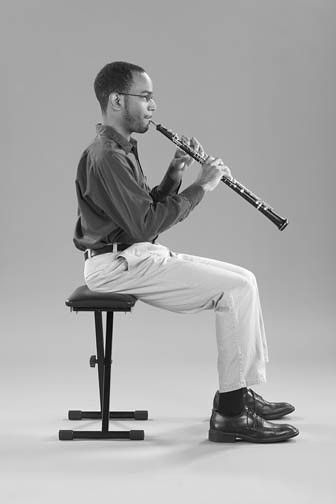
Yet I’ve observed that few music students know how to sit optimally and, as a result, many endure frequent episodes of back pain.

Here are 4 principles that contribute to easeful sitting. All are expanded on in The Musician’s Way (p. 250-269), which includes dozens of high-resolution photos.

Continue Reading

Soulful Control

“In music, one must think with the heart and feel with the brain”
–George Szell, conductor

Have you ever heard a note-perfect performance that was emotionally sterile or, on the flipside, a passionate one that was unbearably sloppy?

I’ve found that such performances occur often among music students.

And I think I know why as well as what to do about it. Continue Reading

Feeling Ahead

“The mind always has to anticipate the physical action that is to be taken
and then to send the command for its execution.”
–Ivan Galamian, violin teacher (The Musician’s Way, p. 48)

If I were asked to name the central skill involved in secure, artistic music performance, I wouldn’t hesitate.

I’d answer that it’s the ability to sense musical gestures before executing them.

That is, to play or sing a phrase fluently, we have to ‘hear’ it in our minds and perceive the sensations of executing it. Continue Reading

Resources for Instrumentalists & Singers

Miles Davis

“Don’t play what’s there, play what’s not there.”
–Miles Davis, trumpeter and composer

Miles Davis poetically captures the essence of artistic musicianship.

That is, we don’t pursue musical excellence to retrace other performers’ steps. Rather, we strive to express our unique musical voices and create something new.

How do we attain such comprehensive fluency? Continue Reading

Mastery and Mystery

“The job of the artist is always to deepen the mystery.”
–Francis Bacon, painter

We musicians have much to master along the road to acquiring expertise. And the demands of practice can sometimes be daunting.

But as we build up our skills, we need to remember that, in the process of assembling technical know-how, we also must grow our powers as creative artists.

How do we do that? How do we ‘deepen the mystery’ when practicing the likes of scales, etudes, ensemble parts, and orchestral excerpts? Continue Reading

Glorious Details

“The details are not the details. They make the design.”
–Charles Eames, designer

For musicians and designers alike, our approach to detail largely determines whether our work soars or flops.

Compare, for instance, these two performers: Continue Reading

Projecting Ease

“Masterful performers exhibit ease in all that they do on stage.”
The Musician’s Way, p. 21

There’s no better way for us musicians to make our audiences receptive than to project ease and enjoyment from the stage.

What’s more, by embodying ease, we help dispel any nerves.

To transmit ease, though, we have to not only master our material and be fluent with stage deportment but also draw on the following inner skills.

Continue Reading

Self-Evaluation: The Key to Artful Practice

Itzhak Perlman

“The single most important goal for performing artists
is to see how they are doing.”
–Itzhak Perlman, violinist (The Musician’s Way, p. 202)

Suppose that you’re practicing a new piece. How do you know that one portion is learned securely enough for you to tackle another?

Later on, how do you determine that the music is concert-ready?

Then, following a performance, what enables you to pinpoint the aspects of your execution that need polishing? Continue Reading