* You are viewing Posts Tagged ‘self-evaluation’

Should Soloists Always Perform from Memory?

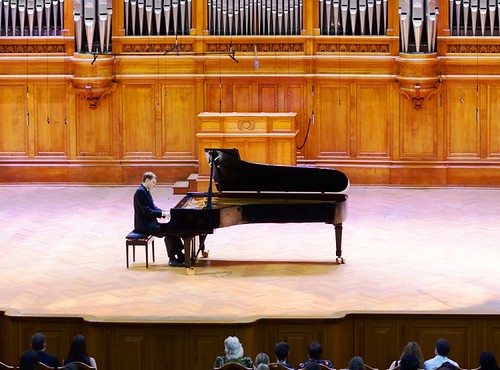
Andre Watts performs from memory with the Atlanta Symphony

“Performing from memory can be a beautiful thing.”
The Musician’s Way, p. 82

As someone who has performed countless solos, I know the upsides and downsides of playing with and without a score.

We musicians often hash over the issue of whether to memorize or not, and pianist Stephen Hough thoughtfully examined the pros and cons in a 2011 article in The Guardian. Continue Reading

4 Steps in the Creative Process

“Take the action and the insight will follow.”
–Anne Lamott, author (The Musician’s Way, p. 107)

Suppose that you want to start a creative project – compose a solo, write a song, design a logo, or whatever.

You’ve done your research and set aside time to work.

Do you typically dive into such projects, or do you tend to procrastinate?

Continue Reading

5 Causes of Musicians’ Injuries

“I continued to play with a sore arm with the rationalization that I could play through the pain and that the discomfort would just miraculously go away as I got into better shape as a cellist. But the pain didn’t go away. It got worse.”
–Janet Horvath, cellist (The Musician’s Way, p. 231)

High-level music making brings immeasurable rewards and also comes with risks of injury.

But if we understand the risks, we can minimize them and position ourselves to keep performing for life.

This post spotlights the 5 main causes of musicians’ injuries (aside from those that affect hearing) along with ways in which we can sidestep common mishaps. Continue Reading

Post-Performance Creativity

“A concert may end when the applause fades, but your artistic work and your responsibilities as a performer are far from complete.”
The Musician’s Way, p. 196

As you exit the stage at the end of a performance, how do you typically feel?

Then, when you interact with listeners and coperformers, how do things go?

Continue Reading

High Standards

“The beauty in playing the instrument is not to be better than the next person
but to stay true to oneself, to set one’s own standards and keep to them.”
–Andrés Cárdenes, violinist (The Musician’s Way, p. 305)

In many ways, we succeed or flounder as artists based on the standards we uphold.

Here are three reasons why.

Continue Reading

Assessing Your Practice Habits

“Wherever you hope to travel on your musical journey,
practice is the only route to getting there.”
The Musician’s Way, p. 3

Although deep practice is essential to musical excellence, in my experience, only a minority of rising musicians practice optimally.

Fortunately, though, practice skills can be learned, but musicians first need benchmarks against which to gauge their habits. Continue Reading

Becoming a Confident Performer

“Your central tasks are finding inner peace and strength, on the one hand,
and being very well-prepared for your performances, on the other.”
Eric Maisel, author & psychologist (The Musician’s Way, p. 146)

In my previous post, “The 3 Roots of Performance Anxiety,” I classified the causes of stage nerves as personal, task-related, or situational.

Here, I point to ways in which we can address those causes and become joyful, artistic performers. Continue Reading

Collaborative Criticism

couple playing piano“You don’t always have to chop with the sword of truth. You can point with it too.”
–Anne Lamott (The Musician’s Way, p. 299)

Although criticism is essential to all sorts of collaboration, poorly handled critiques can undermine our ability to work together.

What if we could manage criticism in ways that enhance collective creativity? Continue Reading

Rebounding from Subpar Performances

Photo of sheet music being blown off music stand“The route to becoming an accomplished musician is seldom smooth and trouble free.”
The Musician’s Way, p. 202

We musicians may dream of performing brilliantly at every show, but, in reality, things don’t always go as well as we’d like.

Especially for students, playing or singing in public can bring upsetting surprises: shakiness, memory slips, music wafting off the stand – you name it. Continue Reading

Stage Power

“I will cast this spell: I know I can open this door and show you something unforgettable and transforming, and I’m determined to take myself there
and to take you with me.”
–Jeffrey Kahane, pianist (The Musician’s Way, p. 177)

When was the last time that you cast a spell from the stage?

If it’s been a while, take heart: I’ve found that nearly all musicians can learn to deliver spellbinding performances, but they first need to build up their stage power.

Continue Reading