



 “There is nothing more fatal for our musical sense, than to allow ourselves – by the hour – to hear musical sounds without really listening to them”
-Tobias Matthay
The Musician’s Way, p. 16
Imagine that you’re watching an artist paint in her studio: She spreads color on canvas, backs up to appraise her work, and then returns to her easel.
Sometimes she brushes briefly and assesses quickly; other times she paints at length before pausing to reflect.
Execution, Evaluation, Revision
Correspondingly, when we musicians practice, we proceed through cycles of execution, evaluation, and revision.
But there’s a big difference between our medium and that of visual artists because music exists in time, not space. After we play or sing a phrase, it’s gone, except for our memory of it.
So, as we practice a passage, if we accurately perceive our execution, and if our memory is keen, we can size up our work and respond fittingly.
But, of course, we’re human, and our perceptions and memories are fallible. If a challenging phrase taxes our capacities, we might not hear every aspect of our sound. Our timing or intonation could drift, let’s say, and we might not notice.
“When we musicians practice, we proceed through cycles of execution, evaluation, and revision.”
Self-recording and Self-perception
Self-recording in practice provides us with the means to compensate for glitches in our self-perception and memory.
It enables us to capture the music we create, and then, like painters, stand back and evaluate our execution from any angle.
In Chapter 1 of The Musician’s Way, I describe the main benefits of self-recording. In this article, I mainly consider audio recorders and how we can use them.
“Self-recording in practice provides us with the means to compensate for glitches in our self-perception and memory.”
Self-recording Gear
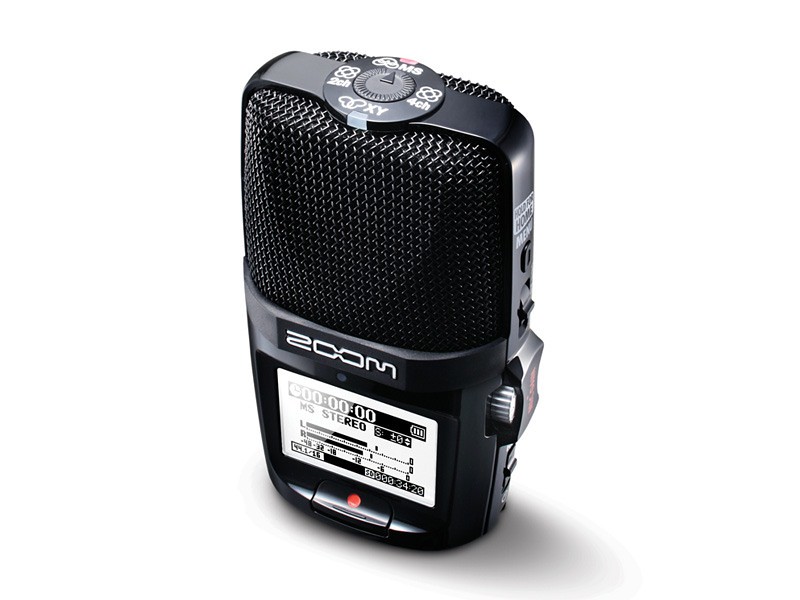
Among the portable digital recorders on the market, for self-recording in practice, I’m partial to the units manufactured by Zoom (please note that I am not a paid endorser of their products). The model H2n is pictured above.
These devices are relatively pocket-sized, come with excellent built-in mics – far superior to the mics on phones, tablets and computers – and they allow for easy data storage and handling.
You can read about their features, watch videos and compare prices via my Amazon Affiliate links below.
Links to Recorders and Reviews:
- Zoom H6. Extraordinary six-track recorder with 32 bit, 96K capability.
- Zoom H4. Outstanding sound quality & features. A musician favorite!
- Zoom H2. A top choice for self-study recording.
- Tascam DR-07X. A less-expensive but good-quality option.
- Zoom Video Recorders.
Using a Recorder
Such recorders can enhance our musicianship in countless ways.
In solo or ensemble practice, we can record a passage and then promptly listen back. If our execution was on target, we might repeat the passage to reinforce excellence. If quality was lacking, we’d solve problems right then.
Similarly, in preparation for a concert or an audition, we might record and evaluate a practice performance; ensemble members might even share such recordings via an online workspace.
Self-recording, therefore, has become integral to almost every serious musician’s creative process.
In my own practice, I always have a recorder at my side. As an educator, I guide my students to record portions of their practice sessions and lessons, and then listen objectively, using their insights to boost their artistry.
Related posts
Assessing Your Practice Habits
Beautiful Repetition
A Different Kind of Slow Practice
Optimizing Practice Time
© 2009 Gerald Klickstein
Updated 2011, 2013, 2014, 2015, 2018
Hi Pete – Thanks for reading. If you’re doing self-study recording, the Tascam will probably work OK, but I think the Zoom H2n is worth the extra money because it’s sturdier and gets consistently excellent reviews. Plus, I’ve had many students who owned Zoom recorders and they’ve all been happy with them.
If you’re going to use the recorder frequently, then you’ll probably be much happier with the Zoom in the long run.
That said, if you’re set on Tascam, you might consider upgrading to the DR-07. On Amazon right now, it’s only about $17 more than the 05, and the mics are directional: http://amzn.to/14zN1Yw
I don’t have any personal experience with those Tascam recorders, though, so please read the reviews on Amazon – they’re most informative – and then let me know what you decide to do and how your new recorder works for you.
I don’t think I need anything as fancy as the Zoom. What do you hear about the Tascam DR-05? Thats more in my price and usage range.
Thanks!
Pete
I’m a big fan of the Zoom H2. I use it to record song ideas, lectures, foreign language practice, etc. Not long after I bought the H2, of course they would upgrade it to the H2n with the larger screen! Oh well. The recordings are clean, with the ability to record in wav. or mp3. Well worth the expense. Thanks, Gerald for reminding us musicians that we absolutely need an audio canvas.
Hi Allen – Love the term “audio canvas”. Thanks for contributing!
i have a zoom h4n and i’m totally blown away by how easy it is to use and how well it records!
Thanks, Greg – I concur! The H4n remains a top choice among portable digital recorders. It’s also on sale at Amazon right now at more than 50% off with free shipping: http://amzn.to/MJdrvT
Hi Brenda. The H2 will more than suffice for self-study recording. But if you want to post recordings on a website or make CDs, then you’d probably want to opt for the superior mics and features on the H4n.
Trying to find compact recorder to evaluate my church’s singing group; I play piano with them. There are about 8 singers and we practice in a small room, singers seated in semi-circle to side and back of piano bench. I haven’t read all your articles on self-recording but the two I did read seem to be geared to soloists. Their concern is that all voices won’t be picked up equally unless we use individual mics. I’m looking for cost-effective and portable equipment. Thanks for any advice.
Self-recording has helped me in all the ways that you mentioned and in one that you haven’t mentioned. I don’t have easy access to a master teacher and must rely on my self-recordings and my ears to discover problems that I may be having with certain passages in a piece. When I listen to myself, I can then take notes about the problem areas, and determine exactly how to trouble-shoot to solve the issue. Often times, for example, I think I am playing a piece with a lot of dynamic variety and come to discover that there are very little audible dynamic changes. I’m getting ready to buy the Zoom Q3 video recorder so that I can watch my body posture, facial expressions, reactions to small mistakes, and overall public presentation.
Thanks for this wonderful resource, Jerry.
Thanks for the informative comment, Dennis, and for the flattering words – much appreciated. For those of you who haven’t heard about the Zoom Q3, info is available via the above link to the part of MusiciansWay.com that features portable digital recorders. The Q3 debuted this month – Sept. 09. It records high-quality audio using the same mics and technology as the Zoom H4n audio recorder and can capture standard-quality video (not hi-def). It’s compact and sells for about $250; it also has an audio-only mode. I haven’t yet seen one, so, Dennis, if you pick one up, please let us know how it works for you – the Q3 is so new that there are few reviews available right now.