



 “Slow practice can establish habits that are completely unrelated to the coordination demanded for speed.”
–Abby Whiteside, pianist
The Musician’s Way, p. 48
All of us acknowledge the value of slow practice: by working at deliberate tempos, we cultivate the ease that allows for speed.
Why is it, then, that some rising musicians who practice slowly can’t bring their material up to tempo?
Simply put, some forms of slow practice support rapid execution, and others don’t.
Here are five ways to ensure that our slow practice instills the habits necessary for high-velocity performance.
5 Slow Practice Techniques that Instill Up-Tempo Habits
1. Sense Movement Groups
To execute quickly, depending on our instrument, we have to move our fingers, tongue, or other body parts in series of movements that I term “movement groups.”
Problem is, at slow tempos, we run the risk of feeling from note to note instead of moving in the integrated gestures required by up-tempo music. So it’s crucial that, when we work slowly and as we increase speed, we sense the same movement groups we’ll rely on at our final tempos.
A simple example: If a pianist practices a left-hand arpeggio using fingers 5-3-2-1, she would want to feel the fingers fall on the keys in a single movement sequence rather than conceiving of four unrelated finger actions.
“At slow tempos, we run the risk of feeling from note to note instead of moving in the integrated gestures required by up-tempo music.”
2. Express Emotional Details
Those movement groups we feel at slow tempos must also convey the emotional fabric of our music. Yet I’ve observed that many students will become inexpressive when they execute slowly, even though they know that emotionless practice embeds unmusical habits.
Therefore, it’s vital that, during slow practice, we expressively shape the passages we’re refining.
If a string player zeroes in on a tricky left-hand shift, let’s say, he would be wise to adjust his metronome to a slow pulse and play with all of the dynamics, accents, articulations, and tone colors called for by the larger phrase.
“It’s vital that, during slow practice, we expressively shape the passages we’re refining.”
 3. Chunk It
In tandem with feeling movement groups and expressive shapes, we also need to conceive of musical gestures as whole entities – chunks. In this way, even when we execute rapidly, our mind moves at an unhurried pace.
But, again, with slow practice, we can unwittingly start thinking in bits, which won’t allow us to perform easily up to speed.
Revisiting that piano example, if the left-hand fingers played continuous 16th notes in a 4/4 measure at a brisk tempo, the pianist would usually want to perceive of the entire measure as one unit as opposed to thinking in four distinct beats.
4. Feel Ahead
With our chunks in place, to establish fluency, we must now sense upcoming chunks as we execute. Such “feeling ahead” is one of the hidden skills that expert musicians employ that commonly goes unnoticed by non-experts.
In fact, I’ve found that students need frequent reminders to feel impending chunks as they play or sing. For some reason, their “feel ahead” switches can be in the “off” position, and they won’t notice.
So let’s be vigilant during slow and fast practice that, as we mold transcendent phrases, we also direct ourselves with an inner conductor – seeing, hearing, feeling, thinking, and imagining ahead as we navigate the musical landscape.
“Feeling ahead is one of the hidden skills that expert musicians employ that commonly goes unnoticed by non-experts.”
5. Modify the Rate of Change
One of the most useful techniques I know for bringing intricate material up to tempo involves slowing the rate of change instead of the tempo (see pages 62-65 of The Musician’s Way for a detailed illustration).
Take the abovementioned piano example – running 16th-notes in a 4/4 measure played by the left hand – and suppose that the harmonies changed on every beat:
• The musician could play the left hand alone near the final tempo, but repeat each harmony 4 times (i.e., repeat the four notes on beat one 4 times before proceeding to repeat the four notes on beat two).
• When that felt easy, each 4-note group could be repeated 2 or 3 times.
• Following that, the pianist might play the first beat once and then repeat the subsequent beat 2 or 3 times.
• When various combinations of single and repeated harmonies became effortless, the pianist would play each beat once, mentally chunking the entire measure and feeling one measure ahead.
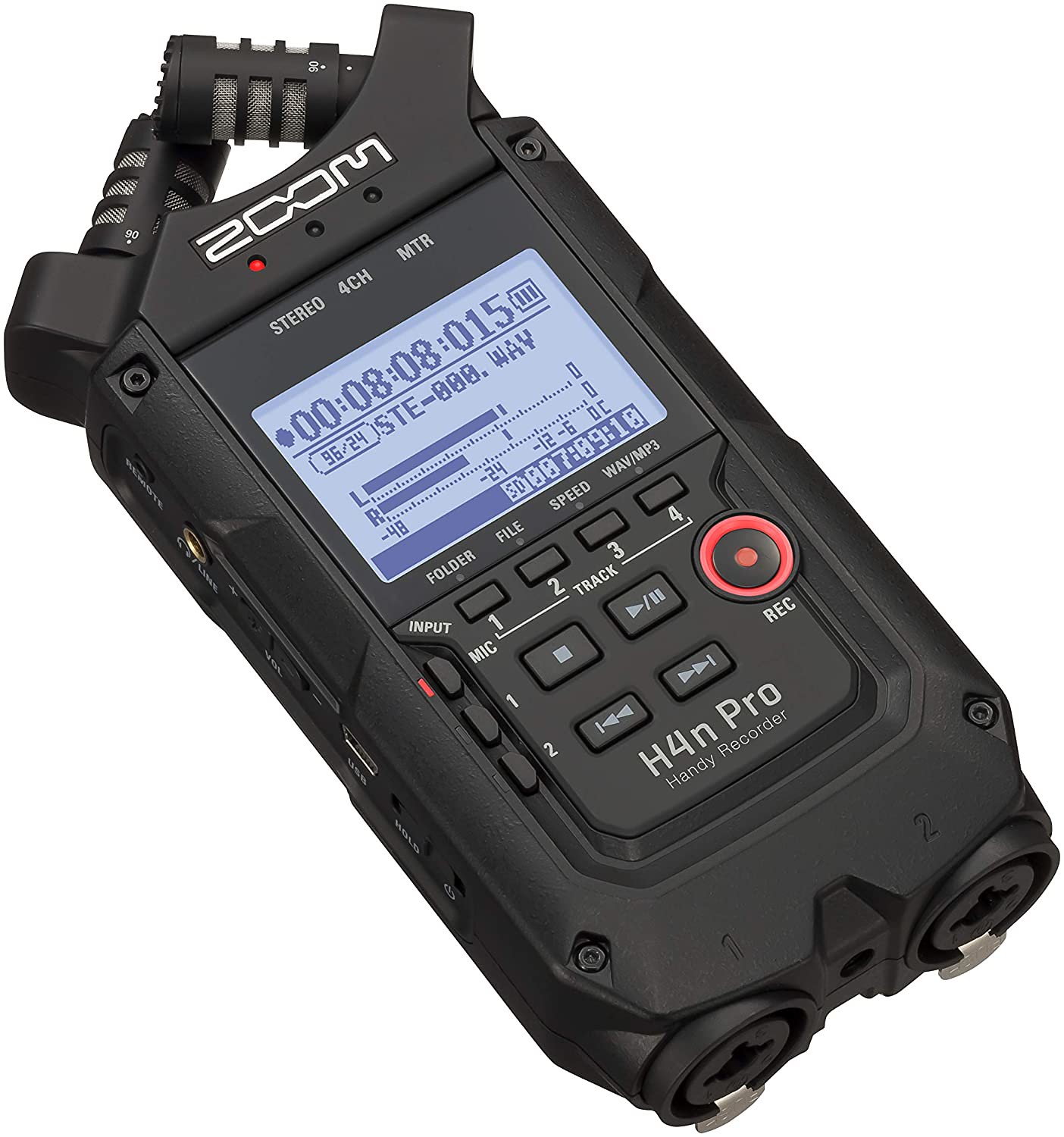
Zoom H4n Recorder
* * *
Lastly, I highly recommend that musicians self-record in practice. Here are some recommended devices:
Recommended Audio & Video Recorders
Zoom H4n Pro. Outstanding & a musician favorite.
Zoom H2n. Excellent for self-study recording.
Zoom Q4n. High-quality video and audio.
See The Musician’s Way for strategies that enable both vocalists and instrumentalists to master practice and performance skills.
Related posts
Feeling ahead
Glorious details
The power of specific goals
Self-evaluation: The key to artful practice
Solving problems in practice
2011 Gerald Klickstein
Thank you Gerald, book ordered!
Thanks, Julian, for your support! I welcome your feedback on the book & invite you to peruse the many companion resources I’ve compiled at https://www.MusiciansWay.com
Thanks for the feedback & suggestion, Julian. I concur with your point. In fact, I discuss varying rhythms along with applications of mental imaging on p. 58-60 of The Musician’s Way (illustrated with music examples). You might be able to preview those pages on Amazon: http://amzn.to/JqrokJ
Excellent article with very interesting ideas that I look forward to using. One other technique for transitioning slow to fast practise is to use different rhythmic patterns – for instance for a passage in 16ths / semiquavers, play it with a dotted rhythm, then fast-fast-slow pattern, then fast-fast-fast-slow etc. This way one can practise playing at speed while programming in ample “think” time to check relaxation and hand position, and mentally prepare the next fast segment.
You’re welcome, Jane. I invite you to let us know how these and other practice strategies work for you.
Thanks for sharing this – lots of good ideas to try out.